The phrase “sustainable architecture” has been repeated so often, across so many different contexts and with such inconsistent meaning, that it has largely lost its capacity to communicate anything precise. It has become, like many terms adopted from serious discourse into marketing language, a signal without content — a way of indicating good intentions without specifying what they require.
We want to try to say what we actually think, which is simpler and more demanding than the phrase usually implies.
The most sustainable building is one that lasts. This is not a sufficient condition — a building that lasts for two hundred years while consuming enormous energy is not, by any reasonable definition, sustainable — but it is a necessary one. A building that is demolished after thirty years, regardless of its energy performance during that period, has consumed the materials and energy of its construction for a fraction of its possible useful life. The carbon embedded in the structure, the foundations, the envelope has not been amortised. The most efficient way to reduce the environmental impact of a building is to extend its life.
This shifts the question from performance metrics to architectural quality. A building that is beautiful, that is well-proportioned, that uses materials honestly, that resolves its details with care — that building will be maintained. It will be adapted rather than demolished. It will be loved, and things that are loved survive. A building that is merely efficient but spatially poor, whose materials age badly, whose construction is legible as cost-reduction — that building will be replaced. The best environmental argument for architectural quality is not abstract. It is practical and economic.
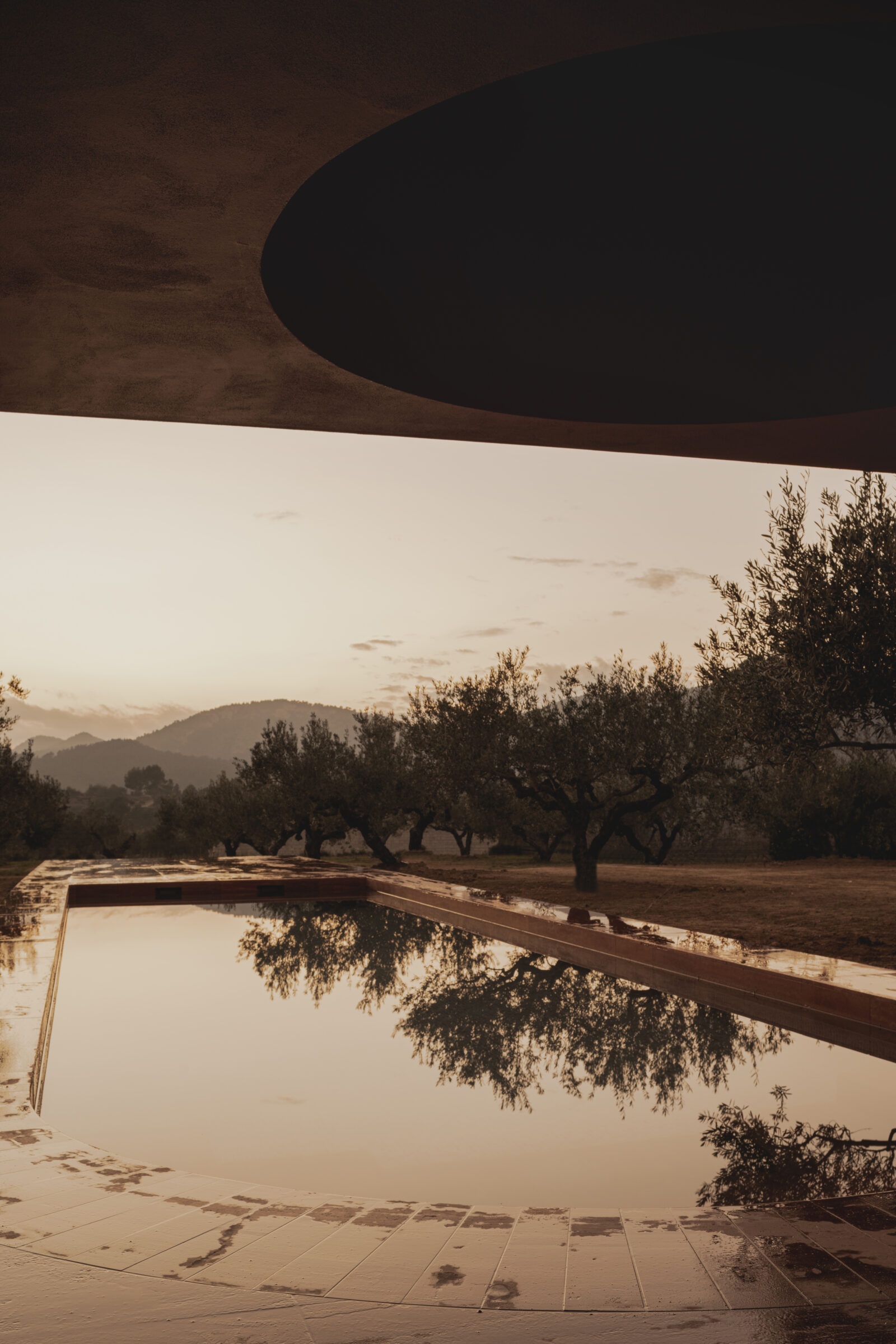
The Casa en los Olivos in Quesa demonstrates this at the level of the technical specification. The house meets Passivhaus standards: high-performance windows, continuous insulation, minimal thermal bridging, mechanical ventilation with heat recovery. Its energy consumption in operation is very low. But the decision to pursue this standard was not separable from the other decisions that shaped the project — the choice of lime mortar for the façade because it breathes and repairs naturally, the use of natural stone because it does not degrade, the linear plan that preserves the olive trees because the landscape is irreplaceable. These are not independent choices. They form a coherent position about what a building is required to do over time.
Climate is also a design condition, not only a performance target. The buildings that perform well in the Mediterranean climate — the traditional farmhouses, the urban residential buildings of the early twentieth century, the rural vernacular — do so because they were designed with a precise understanding of solar angles, prevailing winds, thermal mass and natural ventilation. This knowledge was not codified; it was accumulated through building, through observation, through trial across generations. We do not have the luxury of that time, but we have the analysis that substitutes for it. The orientation of a building, the depth of a shading device, the ratio of glazing to mass — these are calculable decisions that make the difference between a building that works with its climate and one that fights it.
The crisis of climate is not primarily a crisis of technology. We have sufficient technical knowledge to build well. It is a crisis of commitment — of the willingness to accept that building well costs more in the short term, requires more time, demands more from the people who commission it. Architecture cannot resolve this crisis. But it can refuse to be part of the problem, and it can demonstrate, in specific and repeatable ways, that the long-term logic is also the more precise and more beautiful one.
What we resist is the separation of environmental responsibility from design quality. The argument that sustainability and beauty are compatible — that you can have both if you try hard enough — is already too weak. Our position is that they are the same thing, approached from different directions. A building that is made to last, that is honest about its materials, that works with its climate rather than against it, that disturbs its site as little as possible and enriches it where it can — that building is also, almost inevitably, a better building. Not as a reward for virtue, but because the same discipline that produces environmental integrity produces spatial quality.
The long term is the only term that matters in architecture. Everything else is provisional.