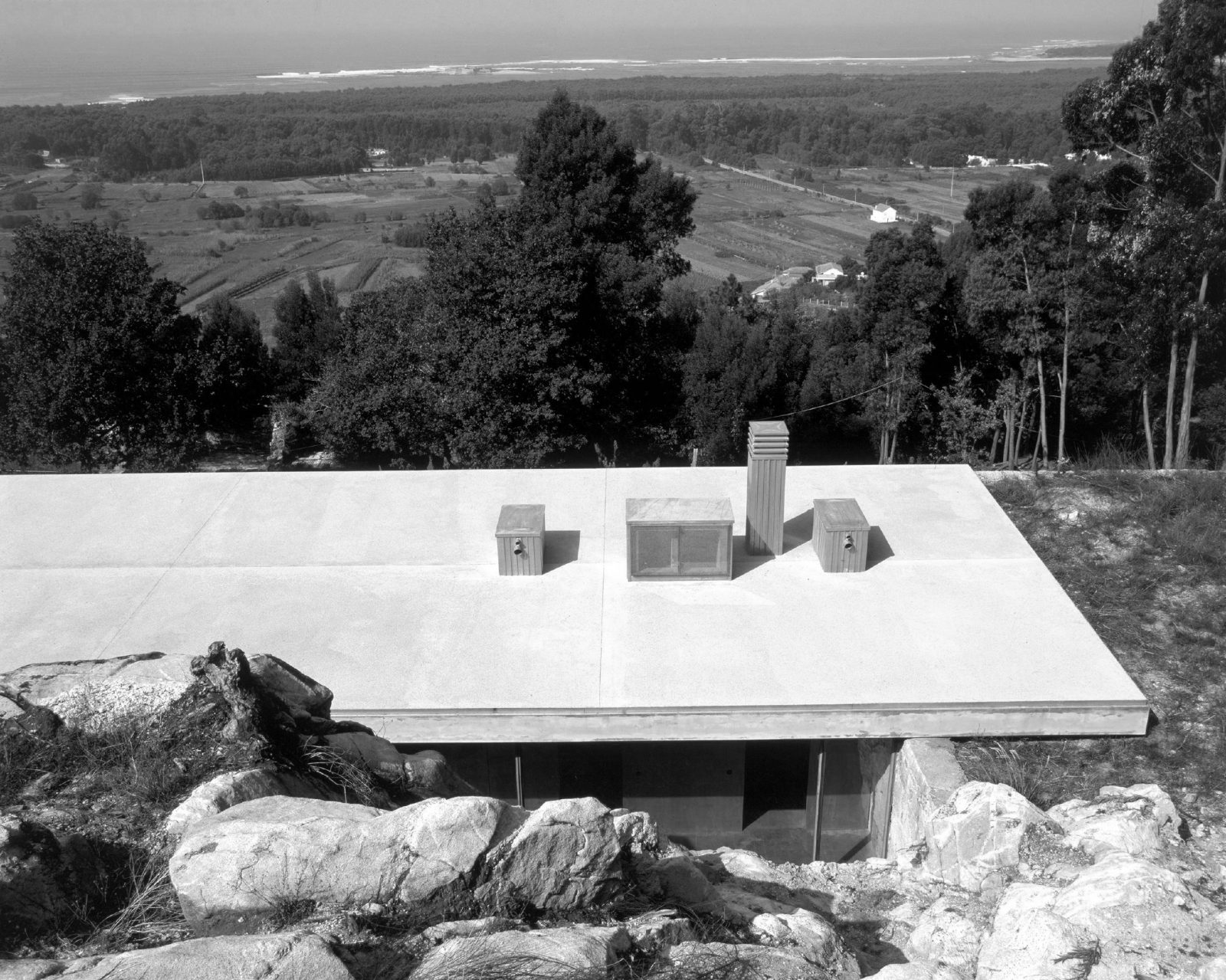
There is a category of building that refuses the condition of the object. Rather than sitting on the ground, presenting itself to a view, declaring its presence against the sky, it disappears into the terrain. It is approached from above. It reveals itself through descent. Its facades, if they exist at all, face down rather than out. The sky is not a backdrop but a ceiling, entered through a cut.
This type of building is not common. It requires a topography that cooperates — a slope, a fall, a difference in level that allows the building to be entered at one elevation and inhabited at another. It requires a client willing to own a house that cannot be photographed from the street. And it requires an architecture that understands the section not as a derivative of the plan but as its primary instrument.
 Chichu Art Museum, Naoshima (2004). Tadao Ando.
Tadao Ando has built several houses of this type in Japan — houses where the entry sequence is a compression that opens into something entirely unexpected at the lower level, where the relationship between the building and the earth is one of mutual penetration rather than superimposition. Peter Zumthor’s thermal baths at Vals work from a similar principle at a larger scale: the building is entered through a cliff, occupies the interior of the mountain, and the experience of the baths is inseparable from the geological weight of the stone above. The architecture and the ground are the same thing.

Our Casa en Denia project works from this condition. The site falls steeply toward an abandoned quarry; the building enters below the access level and concentrates its entire programme on a single lower floor, where light arrives through cuts in the ceiling mass rather than through windows in a wall. From the street, almost nothing is visible. The full spatial experience of the project — its section, its light, its relationship to the quarry geology and the distant landscape — is reserved for those who descend.

What interests us about this building type is the relationship it establishes between architecture and time. A building that sits above the ground ages visibly: its surfaces weather, its silhouette changes against the sky, its presence in the landscape shifts with seasons and light. A building that enters the ground is protected from most of this. Its surfaces are stable; its temperature is moderated by the earth that surrounds it; its relationship to the landscape is fixed rather than contingent. It does not change because its context does not change. This is a particular kind of permanence — not the permanence of the monument, which asserts itself against time, but the permanence of the geological, which simply continues.
Le Corbusier said that architecture is the masterly, correct and magnificent play of masses brought together in light. This is true of buildings that sit above the ground. It does not apply to buildings that enter it. For those, the play is between void and mass, between the excavated and the compressed, between the controlled section of the built interior and the uncontrolled geology of the surrounding terrain. The light that enters is not incidental. It is the only evidence that the building exists.