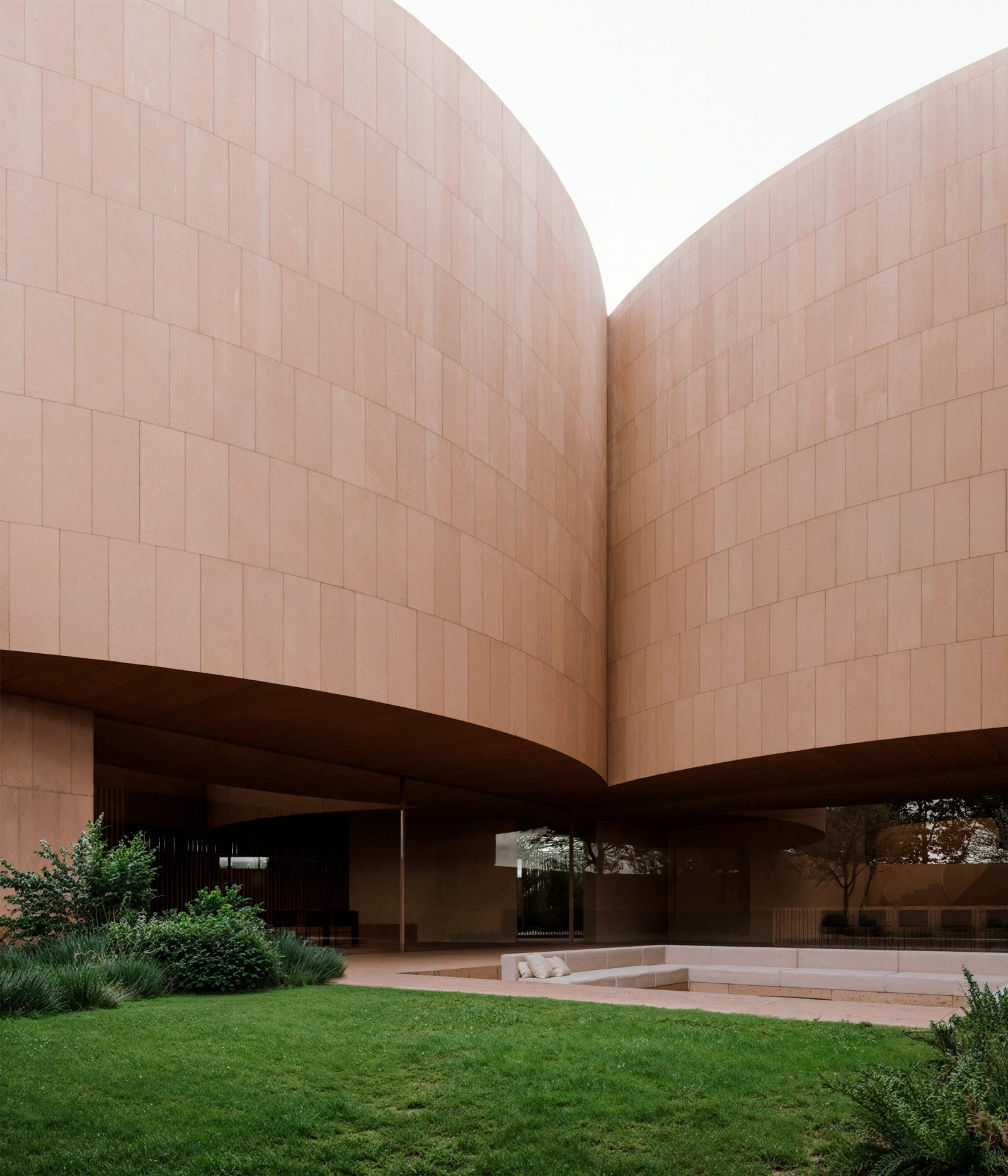
There is a category of house that refuses the street. Its facade offers almost nothing — a wall, a gate, a controlled threshold — and everything it contains is directed inward. The visitor who approaches from outside cannot predict what lies beyond the boundary. The architecture withholds itself until entry.
This is not introversion as a defensive posture. It is a specific spatial logic with a long and distributed history: the courtyard house appears in climates and cultures as different as Moorish Andalusia, Song Dynasty China, and contemporary Kuwait, and in each case it answers the same set of conditions — heat, the value of privacy, the need for outdoor space that is genuinely habitable — with the same formal resolution. The exterior is surrendered. The interior opens to the sky.
The spatial consequence of this decision is considerable. A courtyard is not a garden placed inside a house. It is a volume of air — bounded, proportioned, roofed with sky — that operates on the same terms as any interior room. It has dimensions and acoustic properties. The light that enters it is direct, not filtered through glass: it moves across the day, casts shadows from walls and planted edges, changes the character of adjacent spaces as it travels. An east-facing courtyard at noon is a different room than at dawn. The architecture is not static. It is calibrated to the movement of the sun in a specific latitude, and it cannot be transposed without loss.
What the courtyard also does, less visibly, is regulate. In warm climates, shaded masonry and planted ground moderate temperature through passive cooling. At night, the thermal mass that absorbed heat during the day releases it upward, into the open sky rather than into the interior. The thermal logic and the spatial logic are the same logic. The form is the climate strategy. There is no separation between how the building performs and how it is experienced.
Jørn Utzon understood this when he developed his courtyard house studies in the 1950s, not for any specific warm climate but as a universal spatial proposition. What he identified was that the courtyard house solves a problem that the detached house with peripheral garden cannot resolve: it gives outdoor space that belongs unambiguously to the house, that is enclosed and genuinely private, that can be inhabited without the qualifications a garden subject to wind and street visibility always carries. The sky becomes a ceiling. The transition between inside and outside becomes a deliberate act, not a compromise.
In our work on Round House in Messilah, Kuwait, the courtyard is not one element among others — it is the organizational nucleus around which everything else is arranged. Three circular volumes, each holding a distinct programme, turn toward a central planted garden that functions simultaneously as thermal buffer, spatial anchor, and the only place in the house where all parts of the plan are in relation. The sea view exists, but it is reserved for the upper terraces. The ground floor looks inward. This is a decision, not a limitation: the courtyard gives what no borrowed landscape can — space that is owned, enclosed, and calibrated to the life of the house rather than to the accident of what surrounds it.
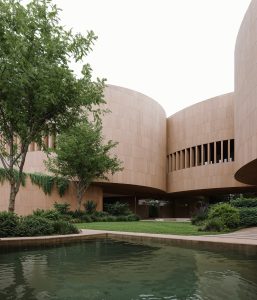
The courtyard house has survived not through sentiment for historical form but because the conditions it addresses have not been resolved by any other configuration. The urban apartment gives enclosure but not ground. The villa in its garden gives ground but not enclosure. The courtyard gives both — at the cost of a facade that performs nothing for the street.
What the exterior offers is a wall. What the building contains is a sky.