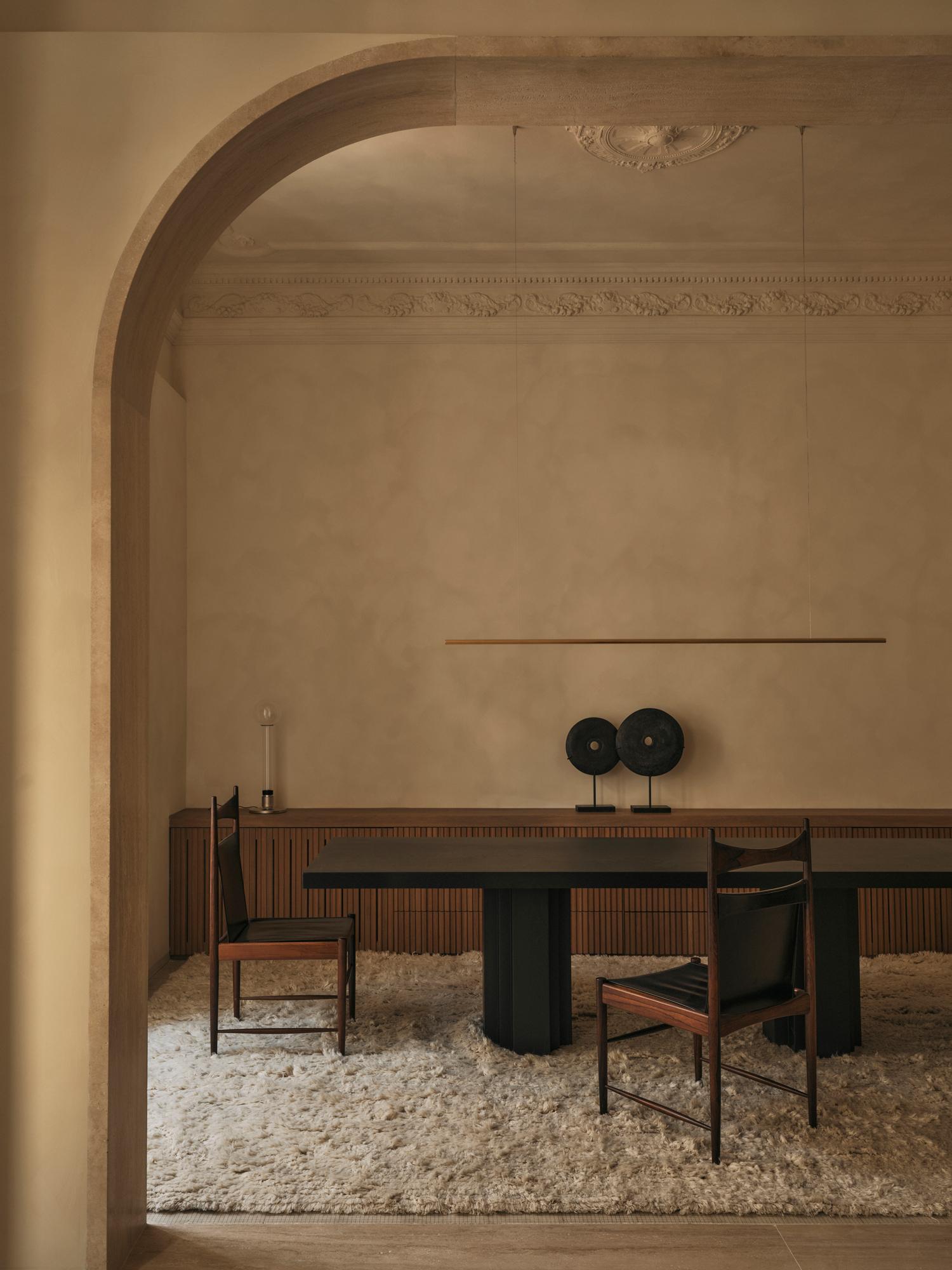
There is a common misunderstanding about restraint in architecture. It is often interpreted as absence — the absence of ornament, of colour, of gesture — as if simplicity were achieved by not doing things. This is not how it works.
Restraint is the result of a sequence of decisions that removes everything which does not serve the work. It is not a starting position. It is an endpoint, reached only after understanding what a building needs to do spatially, structurally, materially, and atmospherically, and then eliminating, one by one, everything that is superfluous to those requirements.
The difficulty is that this process has no objective endpoint. There is always something more that could be removed. The discipline lies in knowing when to stop — when further removal would begin to take away not excess, but necessity.
We find this distinction nowhere more clearly than in the treatment of the joint. The junction between two materials, two planes, two structural elements, is the place where a building declares its intelligence. A joint that is resolved — that brings two things together without pretending the juncture doesn’t exist, without inflating it into a feature, without concealing it behind a cover strip — is one of the clearest signs that a building has been thought through to its end. A joint that is ignored, or decorated away, tells you that the thinking stopped before it reached the detail.
This is what we mean when we say that construction is form. Not that the way something is built determines what it looks like — that is too mechanical an interpretation — but that the formal decisions and the constructive decisions are made simultaneously, each qualifying the other, until neither can be changed without affecting both.
The buildings we return to, across decades and cultures, share this quality: you cannot tell where the idea ends and the making begins. They do not look designed, in the sense of a composition applied to a structure. They look found — as if the building could not have taken any other form given the materials, the site, and the programme. That quality of inevitability is not achieved through simplicity. It is achieved through precision.