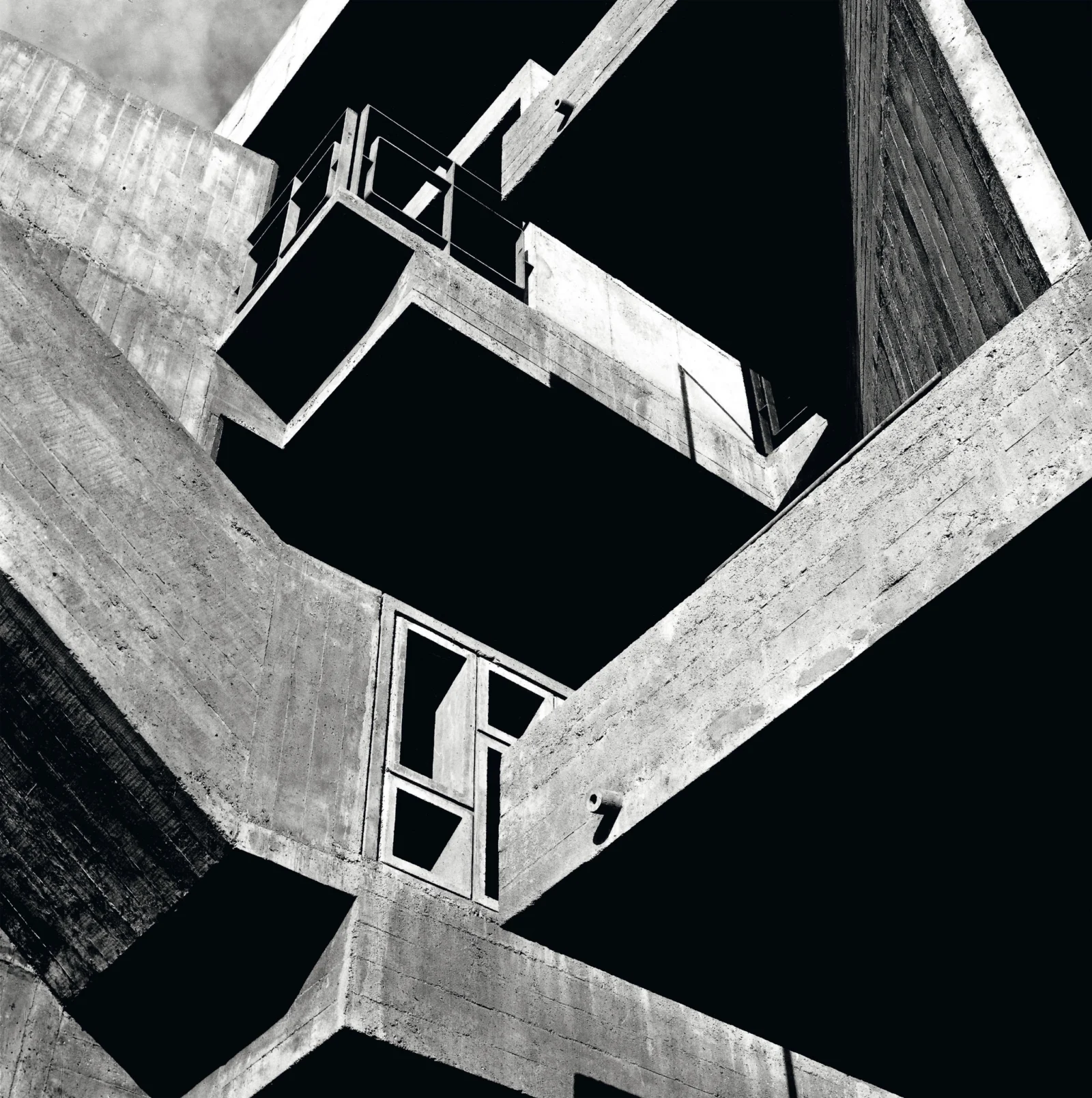
In 1953, the photographer Lucien Hervé visited the Abbey of Le Thoronet, a twelfth-century Cistercian monastery in the Var region of Provence. He was not an architect. He had been a painter and a journalist; his architectural photography had begun only a few years earlier, when Le Corbusier saw his photographs of the Unité d’Habitation in Marseille and immediately offered him the role of official photographer for his work. Hervé accepted. What followed was one of the most consequential collaborations between a photographer and an architect in the twentieth century.
The Le Thoronet photographs are something else entirely. They are not documentation. They are not record. They are an act of spatial understanding conducted entirely through the camera, by someone without formal training in architecture, who arrived at a building that had been standing for eight hundred years and produced images that no architect had managed to produce before him.
 Abbaye du Thoronet, 2003, Lucien Hervé. (1910 – 2007)
What Hervé understood — and what the photographs make available to anyone who looks at them carefully — is that Le Thoronet is a building made entirely of proportion and light. There is no ornament, no colour, no programmatic complexity to distract from the spatial logic. The monastery church, the cloister, the chapter house, the refectory: each is a variation on the same formal vocabulary, and Hervé’s camera traces that vocabulary with methodical patience. He photographs the same wall at different times of day to show what the light does to the surface. He positions the camera at threshold points — doorways, arches, the junction between cloister and garden — to show the spatial relationships between volumes. He photographs upward into vaults to make visible the geometry that governs the section.
Le Corbusier’s preface to the book contains a sentence that has stayed with us: “Light and shade are the loudspeakers of this architecture of truth, tranquility and strength.” It is a sentence that could only have been written by someone confronted with Hervé’s photographs, not by someone who had visited the building — or rather, it is a sentence that the photographs make possible in a way that memory alone cannot. The camera fixed what the eye passes through.
 Abbaye du Thoronet, 2003, Lucien Hervé. (1910 – 2007)
We keep the book in the studio. Not as a historical reference or an academic source, but as a calibration instrument. When a project is becoming complicated in ways it should not be — when materials are multiplying, when the section is losing clarity, when decisions are being made by addition rather than by removal — we open it.
The question it poses is always the same: is what you are doing necessary? Le Thoronet is not an argument for austerity as a style. It is an argument for the sufficiency of proportion, material, and light when all three are in the right relationship. Everything else is optional.
Hervé’s photographs make this argument more persuasively than any text. That is what the best architectural photography does: it does not document a building. It reveals what the building knows about itself.