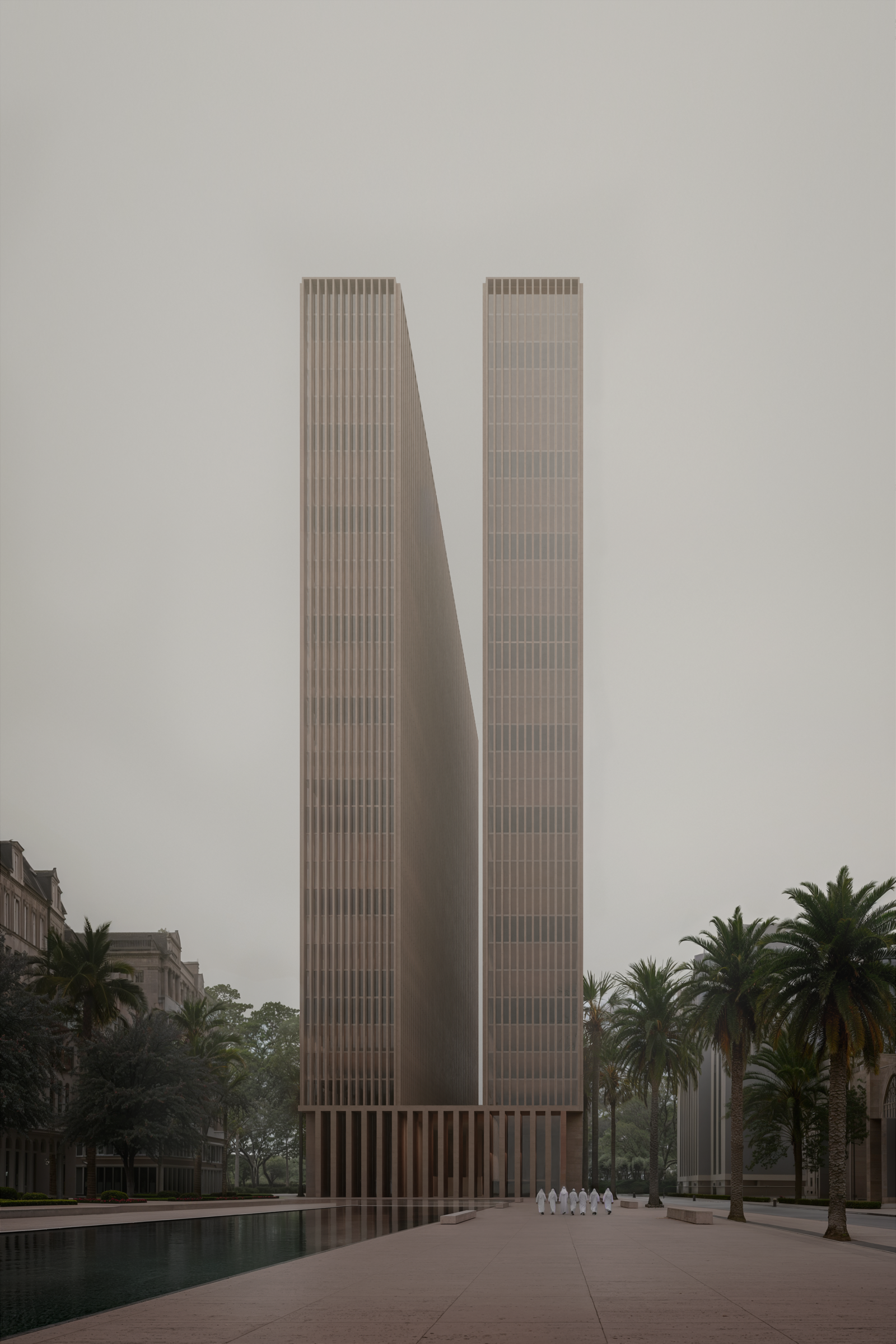
Barzakh is an Arabic word with no direct equivalent in European languages. It means, roughly, an intermediate space — a zone between two conditions that is neither one nor the other, but which has its own distinct character. In Islamic cosmology it describes the state between life and death. In ordinary Arabic usage it can mean a barrier, an isthmus, a narrow passage between two bodies of water.
We began using the word in connection with a project in the Middle East — a two-tower proposal where the space between the buildings was as architecturally considered as the buildings themselves. The gap was not a leftover. It was a threshold: a space that mediated between the public realm and the private, between the scale of the city and the scale of the individual.
The concept has stayed with us, because it describes something we encounter in almost every project, at every scale.
Every building has at least one barzakh — at least one moment where two conditions meet and the architecture must negotiate their relationship. The front door is the most obvious: the threshold between inside and outside, public and private, the city and the house. Get this moment wrong and no amount of resolution elsewhere can compensate. The threshold is the building’s first statement about what kind of space lies beyond.
But threshold exists at every scale. The reveal between wall and ceiling. The step up from a living space to a kitchen. The transition between a garden that is managed and vegetation that is not. Each of these is a barzakh — a moment where the architecture has to decide how two things relate, and where the quality of that decision is visible.
What we have come to understand is that these threshold moments are not merely transitions. They are the places where a building concentrates its meaning. A room can be experienced from anywhere within it, but its character is defined at its edges — at the wall, at the floor, at the point where it opens into another space. The threshold is where architecture happens.
This is why the detail matters. Not as craftsmanship for its own sake, but because the detail is where the threshold is resolved. A window frame that meets the wall cleanly tells you something about how the building understands inside and outside. A staircase that arrives at a landing with the right proportion tells you something about the building’s sense of sequence and pause. These are not decorative decisions. They are spatial decisions expressed in material terms.
Barzakh is not a design concept we apply. It is a quality we look for — in the projects we study, in the buildings we visit, in the work we produce. When a space has it, the building feels complete. When it is missing, something is always slightly unresolved, even if you cannot immediately say what.