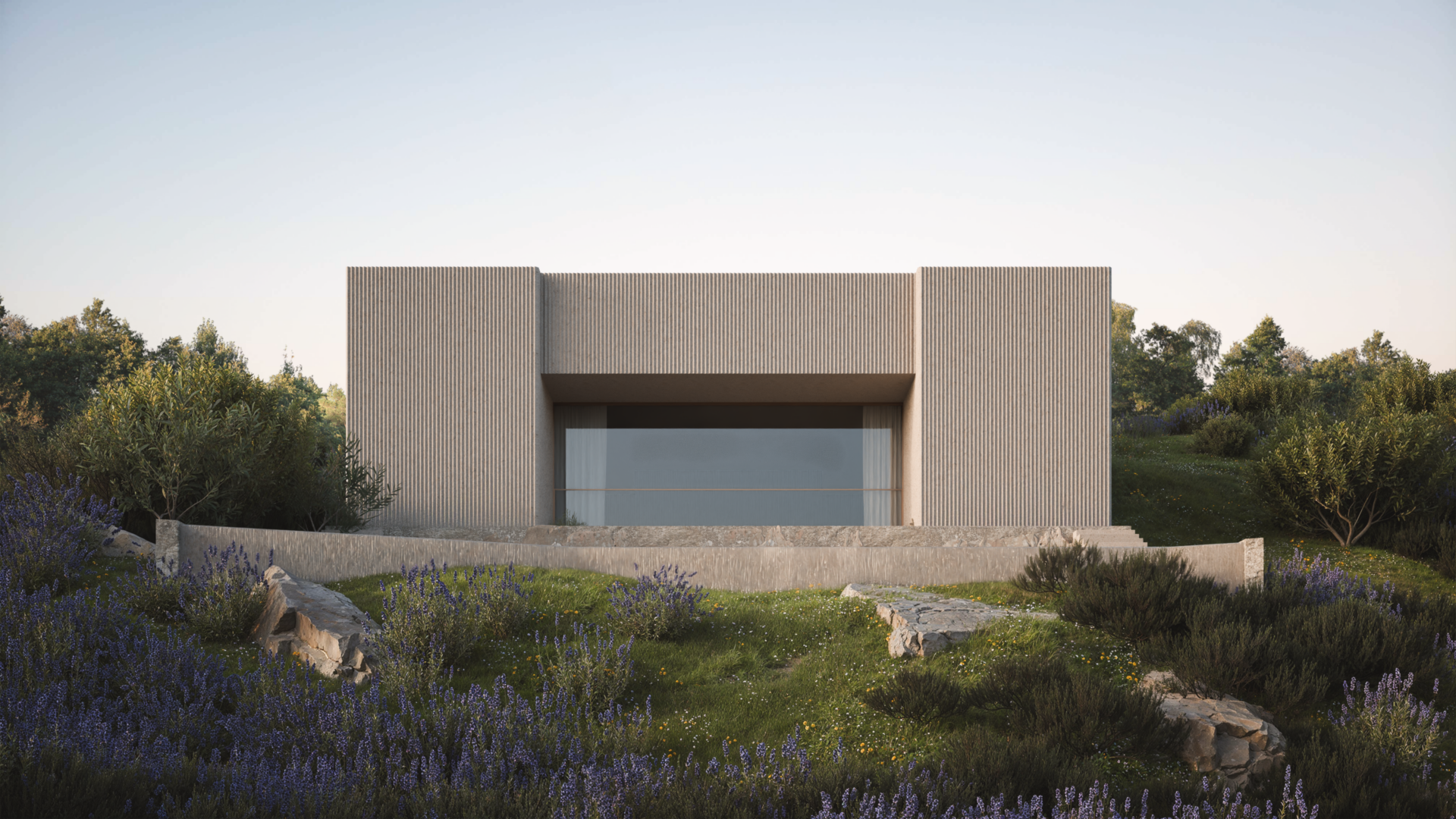
基地朝低处一处废弃的采石场陡降。住宅不坐落于此景观之上,它进入其中。从街道望去,建筑几乎不被察觉。两个侧向体量夹住一处抬升的入口平台。下降由此开始:一段引导向下、低于进入标高、到达功能展开之处的序列。住宅在你进入其中之前并不可见。
The surrounding neighbourhood is built without compositional coherence, single-family houses of different periods and typologies, implanted on the hillside without a common language. The project responds with a single, autonomous piece: contained, serene, oriented entirely toward the landscape it has chosen to inhabit rather than toward the street it faces.
From outside, at the level of access, the house presents almost nothing. Two volumes, a platform, a threshold. The full spatial experience is reserved for the interior.


The abandoned quarry at the foot of the site is not directly visible from within the house, the topography prevents it. But its presence runs through every material decision: the rough mineral texture of the exterior surfaces, the density of the enclosing walls, the logic of a building that does not stand above its terrain but occupies it from within.
The quarry’s cuts in the rock, stratified, geological, made by extraction rather than by design, are the reference for the house’s own openings: not punctuations on a vertical plane, but excavations in a solid mass.
The entire plan is organized on a single lower level. Light enters through deep cuts in the ceiling mass and excavated interior patios rather than through conventional openings on a vertical facade. The section controls the quality of that light, its direction, its duration, its angle at different moments of the day, more precisely than any window could.
The result is a house of controlled shadow and precise illumination. The relationship between a space and its light is not ambient but specific: each room receives the light its function requires.
The descent from the access platform to the lower level, where the entire programme unfolds. Deep cuts in the ceiling mass and excavated interior patios deliver light to each room without conventional openings on a vertical facade.