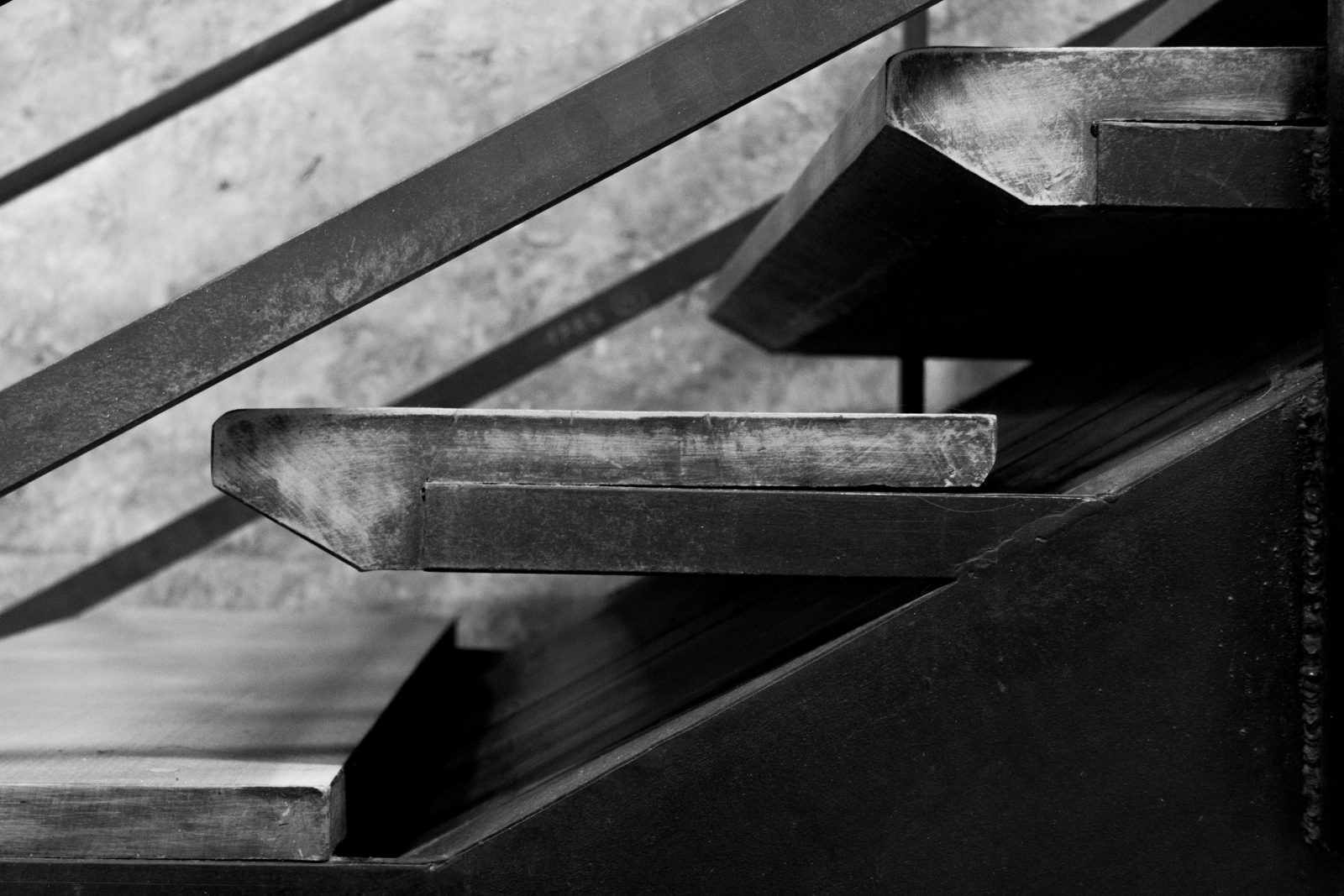
The staircase is the only element of a building that requires the body to move through it in a predetermined way. The step pitch determines your pace. You cannot pause without disrupting the rhythm. The staircase is architecture at its most controlling: it imposes its geometry on the body, and in doing so it reveals the spatial ambitions — or the spatial indifference — of whoever designed it.
In most buildings, the staircase is a residual problem. Having organised the plan, the architect places the stair wherever space remains. A core, a service spine, a minimum legal width repeated floor after floor. It moves people between levels efficiently and is then forgotten. This is not a neutral choice. A stair placed as leftover is a building that considers vertical movement a problem to be solved, not a spatial experience to be offered.
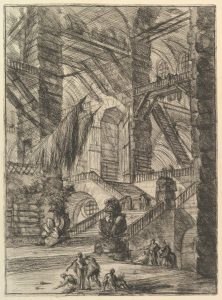
The alternative tradition is clear. In Giovanni Battista Piranesi’s Carceri — the series of imaginary prisons etched in Rome in the 1740s — the staircase becomes the subject of the image. His spaces are built from escalating levels, bridges, and landings that lead nowhere conclusive. The stair, freed from any destination, becomes spatial event in itself. Piranesi was not designing buildings. He was isolating an experience that architecture usually buries inside function.
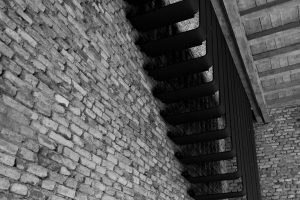
Carlo Scarpa understood this. At the Castelvecchio Museum in Verona, the approach to the equestrian statue of Cangrande della Scala is orchestrated through a sequence of elevation changes — ramps, steps, shifts in floor level — that force the visitor to encounter the sculpture from below, then beside, then from slightly above. The staircase, distributed and fragmentary, becomes the experience of the collection. You do not walk past things; you rise and fall through them.
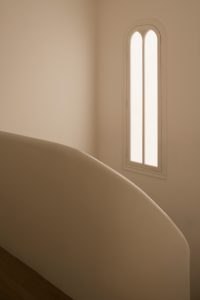
There is also the matter of the landing. The landing is where the staircase creates a room of its own — a pause between ascent and arrival. In a generous stair, the landing is an event: a moment of orientation, of light, sometimes of view or rest. In a mean stair, it is merely a place to change direction. The difference between these two is the difference between a building that offers its inhabitants a spatial gift and one that withholds it.
In residential architecture, the staircase is the spine of domestic time. It is where the child descends on a winter morning, where the owner pauses at dawn before the household wakes. In our work on the 1928 Penthouse in Valencia, the proportional logic of the original building governed every new intervention. The curved staircase connecting the main level to the rooftop was not decoration: it was the vertical extension of a spatial sequence the building had been waiting to complete. To arrive on the roof was to finish a movement the stair had already begun.
In warm climates, the staircase carries an additional dimension. The stairwell is a column of warm air; an open stair through multiple levels becomes a natural convection path. Traditional houses in the Mediterranean and the Gulf often place staircases centrally and openly in part because their presence improves air movement through the section. The stair that works spatially also works climatically.
To design a staircase seriously is to take a position on what vertical movement means in a building. It is to decide how much time the body deserves for the passage between levels. A wide, slow, well-lit stair argues that the journey matters.
The stair is always also a philosophy.